

Why Room Correction Isn't a Premium Feature — It's the Only Honest One.
Room correction isn’t a luxury—it’s essential. Learn how room acoustics distort sound and why tuning audio to your space matters more than specs or power.
My post content
Why Room Correction Isn't a Premium Feature — It's the Only Honest One.
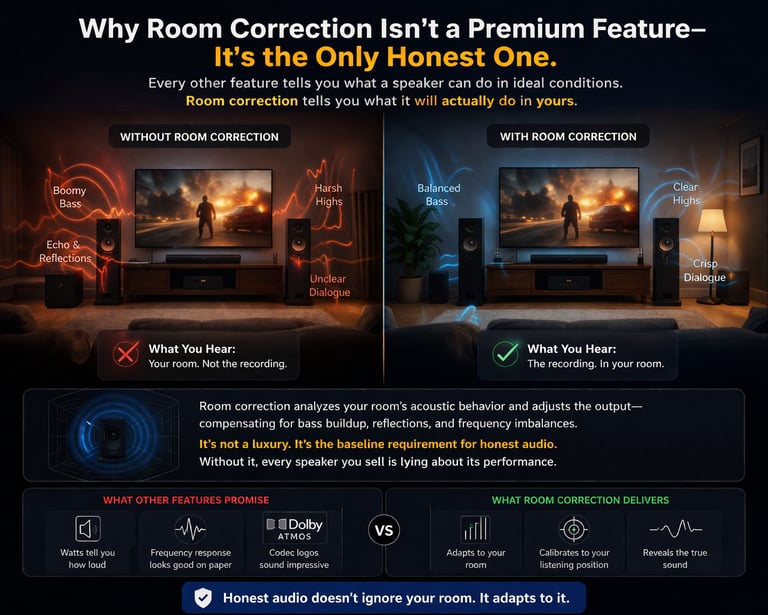
Every other feature tells you what a speaker can do in ideal conditions. Room correction tells you what it will actually do in yours.
The audio industry has an interesting habit of making the most essential technology sound like an optional extra.
Room correction — the ability of an audio system to analyze its acoustic environment and adjust its output accordingly — is marketed as a high-end feature. Something for the enthusiast. Something for the person spending ₹80,000 on a home theatre setup. A luxury.
This is backwards.
Room correction is not a luxury for people who want better audio. It's the baseline requirement for honest audio. Without it, every speaker you sell is lying about its performance.
What Room Correction Actually Does
When an audio system plays sound in a real room, the room changes everything. Bass frequencies accumulate in corners. Standing waves create artificially loud or quiet spots at specific frequencies. Early reflections from walls alter the perceived stereo image. Ceiling bounce changes the timing of sound arrival.
A speaker with no room awareness plays a fixed output into this chaos and hopes for the best. Room correction measures the acoustic behavior of the room and compensates for it — pulling back frequencies where the room boosts them, reinforcing frequencies where the room absorbs them, and timing adjustments to account for reflection arrival.
Why It's Called a Premium Feature (And Why That's Wrong)
Room correction became associated with premium products for a simple reason: early versions of the technology were computationally expensive. DSP processing power was limited and costly. Auto-calibration systems required dedicated microphones and analysis time. The first products to include it were high-end AV receivers costing hundreds of thousands of rupees.
That was twenty years ago.
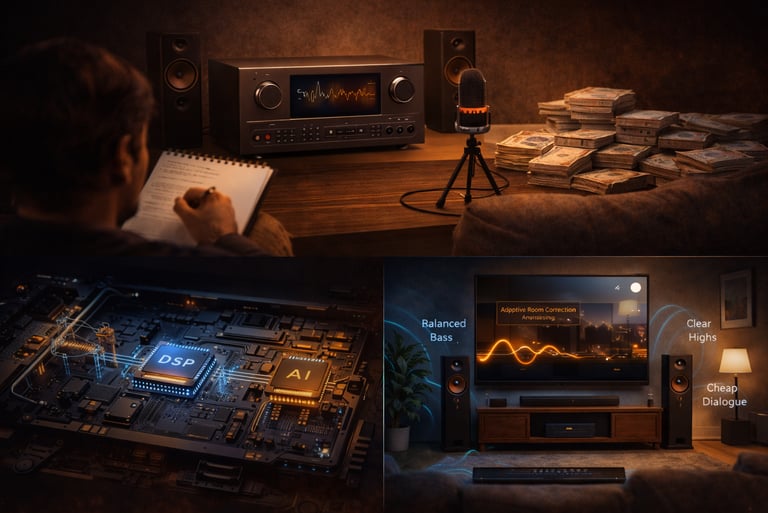
Today, DSP processing is cheap. Microphone arrays are cheap. AI inference is cheap. The cost of including room analysis and correction in a consumer audio product is a fraction of what it was when the industry decided to position it as a premium differentiator.
But the positioning stuck. Because if room correction becomes the baseline expectation for all speakers, it eliminates a premium category that the industry profits from. So it remains, by convention, a 'high-end feature' — even though the technology required is no longer scarce.
What Good Room Correction Looks Like
Not all room correction is equal. Passive room correction uses a fixed microphone measurement taken once at setup and applies a static correction curve. Better than nothing, but it doesn't account for changes in the room — furniture rearrangement, doors open vs closed, number of people in the room.
Active room correction continuously measures and adjusts. AI-driven room optimization does this in real time, using ongoing acoustic feedback to tune output dynamically rather than relying on a single static measurement.
Markers of genuine room correction:
Includes a measurement process — the system plays test tones or uses an array to map the room
Adjusts per frequency — not just overall volume, but frequency-specific compensation
Accounts for listening position — ideally, calibrated to where you actually sit
Updates dynamically — not a one-time measurement but an ongoing process
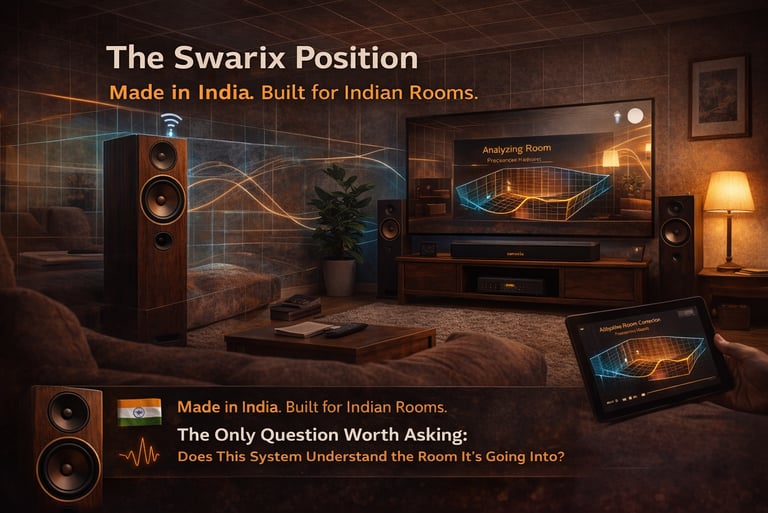
The Swarix Position
We built room scanning and AI-based sound optimization into Swarix from the beginning — not as a premium tier or an add-on, but as the foundation of how our products work.
Our view is straightforward: selling a speaker without room awareness is like selling a navigation system without GPS. You can have the most detailed maps in the world, but if the system doesn't know where it is, it cannot help you get where you're going.
Our room scanning technology detects your room's dimensions and acoustic characteristics before tuning audio output. Our AI-based sound optimization adjusts in real time. Our wooden enclosures eliminate the internal resonance that plastic adds to every frequency you hear. And all of this is built into products priced to compete in the ₹10,000–₹20,000 segment.
Room correction is not a premium feature at Swarix. It's the starting point.
Made in India. Built for Indian Rooms.
Indian homes — their dimensions, materials, ceiling heights, and acoustic challenges — shaped every design decision we made. Swarix is not a global product adapted for India. It is an Indian product built for the acoustic reality of Indian homes.
The Only Question Worth Asking
The next time you're evaluating an audio purchase, skip the watts. Skip the codec logos. Skip the frequency response numbers.
Ask one question: Does this system understand the room it's going into?
If the answer is no — if the product plays a fixed output regardless of the acoustic environment it's in — then every other specification is a promise made in a lab that your living room was never consulted about.
You deserve better than that. Your room deserves better than that.
Innovate
Connect
info@swarix.com
© 2025. All rights reserved.