

The Loudness War: Why Your Ads Are Louder Than Your Movie.
Why are ads always louder than movies? Understand the loudness war, audio compression, and why modern content sounds inconsistent across devices.
My post content
The Loudness War: Why Your Ads Are Louder Than Your Movie.
DTH broadcasters in India inject ads at 8–10 LUFS above content loudness. This is deliberate. This is measurable. And this is completely solvable.
You're watching a film. It's a quiet, tense scene — low dialogue, subtle background score. You've turned up the volume to catch every word.
Then the ad break hits.
In the half-second before your hand reaches the remote, your neighbors have already heard it. The volume difference is not subtle. It's jarring. It feels like someone else made a choice about your living room's volume without asking you.
They did. And it was a very deliberate choice.
What Is LUFS?
LUFS stands for Loudness Units relative to Full Scale. It's the standard unit used by broadcasters, streaming platforms, and audio engineers to measure the perceived loudness of audio content. Unlike simple decibels, LUFS accounts for how human hearing perceives loudness — a much more useful measure for practical audio work.
The higher the LUFS value (closer to 0), the louder the audio sounds to your ear. The lower the value (more negative), the quieter.
International broadcast standards (like EBU R128, used in Europe) recommend television content be broadcast at -23 LUFS. Streaming platforms like Spotify target -14 LUFS. These are standards designed to create consistent loudness across different content so your ears don't get assaulted every time content changes.
The gap between typical content loudness and ad loudness on Indian DTH broadcasts is measurable and consistent. It is not an accident of compression algorithms. It is an engineered decision.
Why Broadcasters Do This
The loudness of an advertisement directly correlates with its recall and perceived impact. Ads that play louder are noticed more, remembered more, and drive more response. This is not speculation — it's documented in advertising research going back decades.
Indian DTH broadcasters and their advertising clients know this. The louder ad is worth more. It gets higher rates. And since there's no technical enforcement of loudness standards in Indian broadcast the way there is in Europe or North America, there's no consequence for the practice.
TRAI (Telecom Regulatory Authority of India) has issued guidelines on commercial loudness over the years, but enforcement has been inconsistent and the problem persists in measurable form.
Why this matters for your audio system
Your TV or soundbar's volume control adjusts overall gain — it doesn't distinguish between content and ads. So if you set volume for comfortable film viewing, ads will always hit louder. If you set volume for comfortable ad viewing, your film dialogue will always be too quiet. This is a structural problem that volume adjustment alone cannot solve.
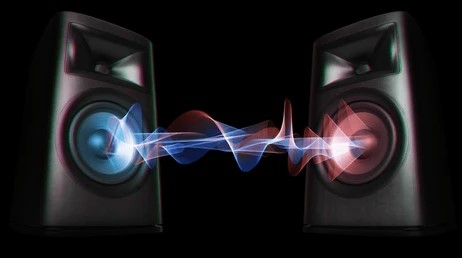
The Dynamic Range Problem in Indian Broadcasting
Beyond the loudness war between content and ads, there's a separate problem inside the content itself.
Modern OTT content — Netflix films, Amazon originals, theatrical releases — are mixed with wide dynamic range. Quiet dialogue might sit at -40 LUFS. An action sequence might peak at -10 LUFS. This 30dB range is intentional. It creates cinematic impact. It's how the director and sound designer intended you to experience the film.
DTH broadcast compresses this range to fit broadcast constraints. The quiet dialogue gets louder. The loud action gets quieter. The dynamic expression of the mix collapses into a narrow band that's easier to manage for broadcast but significantly less engaging to hear.
This is why the same film on Netflix through a streaming device sounds better than the same film on a DTH channel — even when the audio format listed is identical.
What a Smart Audio System Actually Does About This
Most soundbars respond to loudness shifts the same way you do: they can't. They play whatever signal arrives at whatever level it arrives.
An AI-driven audio system with real-time dynamic adjustment can do something different: it can normalize perceived loudness continuously, bringing ad audio down and dialogue audio up without the crude ceiling of a manual volume control. This is not a simple compressor or limiter — it's intelligent loudness management that preserves dynamic expression within content while smoothing the jarring transitions between content types.
Swarix's AI-based sound optimization includes adaptive dynamic processing that works in real time — ensuring your film dialogue stays audible, your action sequences retain impact, and your ad breaks stop announcing themselves to your entire building.
This is not a gimmick. It is the answer to a real, documented, and ongoing problem in Indian broadcast audio.
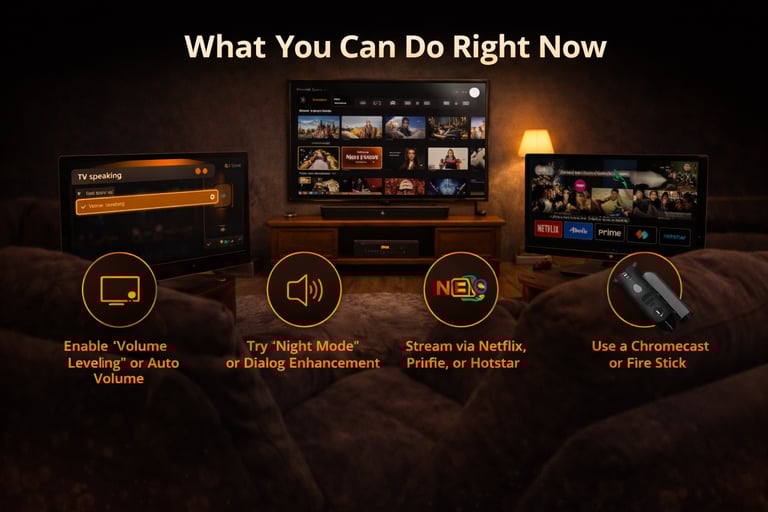
What You Can Do Right Now
Until you have a system with built-in dynamic audio management, here are practical approaches:
Use your TV's built-in 'Volume Leveling' or 'Auto Volume' feature if available — it's imprecise but better than nothing
Enable 'Night Mode' or 'Dialog Enhancement' on your soundbar during TV viewing — these settings often apply mild compression that reduces loudness swings
Switch to OTT streaming where possible — Netflix, Prime, and Hotstar all apply loudness normalization (-14 to -16 LUFS), creating more consistent audio
Consider a dedicated streaming device (Chromecast, Fire Stick) rather than your DTH box for OTT content — the audio path is often cleaner
The loudness war is real, it's deliberate, and it's been happening in your living room every day. Knowing why it happens is the first step. Having hardware and software intelligent enough to manage it is the solution.
Innovate
Connect
info@swarix.com
© 2025. All rights reserved.