

The Dirty Secret of Speaker Specifications.
Speaker specs don’t tell the full story. Learn how wattage, frequency response, and marketing tricks mislead buyers—and what actually matters for real sound quality.
The Dirty Secret of Speaker Specifications.
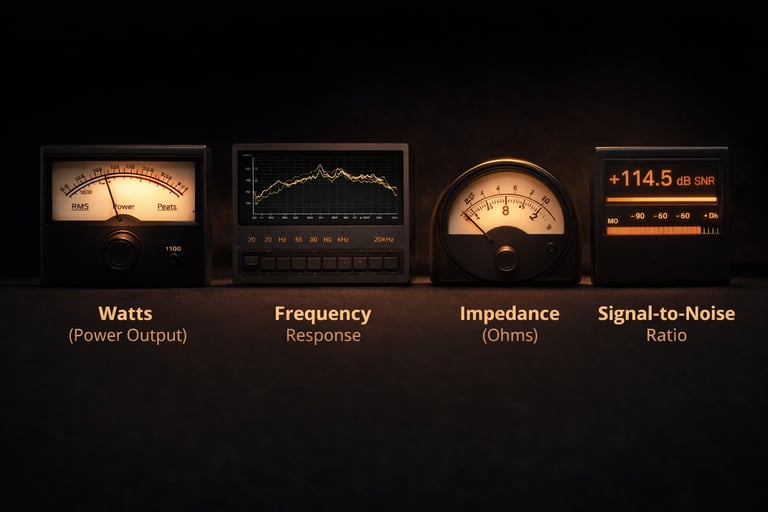
Watts, frequency range, impedance — every number on a spec sheet is measured in a lab with no walls. In your living room, every single one of them lies.
You did the research. You compared watts output. You checked frequency response. You read about impedance. You looked at the signal-to-noise ratio. You made what felt like an informed, data-driven decision.
And when the speaker arrived, it sounded nothing like those numbers suggested it would.
This is not a coincidence. This is the spec sheet industry.
The core problem
Every number on a speaker specification sheet is measured in an anechoic chamber — a room designed to eliminate all sound reflections. No walls. No ceiling bounce. No floor reflection. A scientifically perfect environment that exists nowhere in the real world.
Let's Go Through Each Specification
Watts (Power Output)
Watts is the metric most buyers focus on first, and it is the least meaningful in real-world use.
The problem: speaker manufacturers use different methods to measure wattage. RMS (continuous) wattage is the honest number — the power the speaker can sustain during normal listening. Peak wattage is what the speaker can handle for a fraction of a second at maximum strain. Many manufacturers print the peak number prominently and the RMS number in small print.
A 100W peak speaker and a 30W RMS speaker might be exactly the same product. In your room, the RMS number is what matters — and that number is usually 3-4x lower than the marketed watts.
More importantly: watts tells you about volume capacity, not sound quality. A 20W speaker with great acoustic design will sound better than a 200W speaker with a poor enclosure in the same room.
Frequency Response (Hz to kHz)
Most speakers claim something like: 20Hz – 20kHz. This sounds impressive because 20Hz to 20kHz is the complete range of human hearing. But the specification almost never includes the tolerance.
In professional audio, frequency response is typically stated as '20Hz – 20kHz ±3dB' — meaning the output stays within 3 decibels of flat across that range. Consumer speaker specs often omit this tolerance, because if they included it honestly, the range would look far less impressive.
A speaker claiming 20Hz bass response that's 20dB down at 20Hz is technically not lying. That frequency exists in the output. It's just barely audible — 20dB is roughly one-quarter of perceived loudness.
In your room, bass response changes dramatically based on your room dimensions, where you're sitting, and how the room resonates. A speaker's rated bass response and your room's bass behavior are two different things entirely.
Impedance (Ohms)
Impedance affects how your amplifier and speaker interact. Mismatched impedance can cause distortion or damage. However, impedance is not fixed — it varies significantly across different frequencies. A speaker listed as '8 ohm' might dip to 3 ohms at certain bass frequencies.
In practice, for most consumer soundbars and home speakers with built-in amplification, impedance is managed internally. But for external amplifier setups, this specification deserves more attention than it typically gets.
Signal-to-Noise Ratio (dB SNR)
SNR measures how much louder the audio signal is compared to background noise generated by the electronics. A higher SNR (measured in decibels) means cleaner audio. But SNR is measured at a specific test frequency under specific conditions that may not reflect your listening environment.
In a room with real-world electrical interference, reflections, and variable signal inputs, the effective SNR you experience will differ.
The Specification That Actually Matters: How Does It Sound in Your Room?
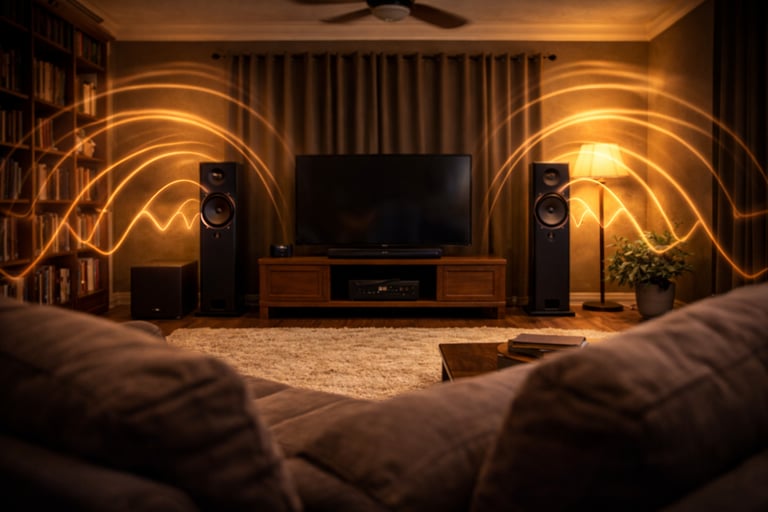
No specification on a product page captures the one thing that matters most: how will this speaker interact with my specific room at my specific listening position.
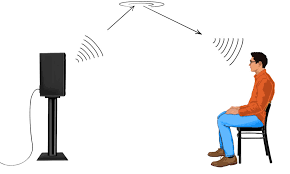
Room gain can boost bass by 6–12dB at low frequencies. First reflections off your walls arrive 5–30 milliseconds after direct sound and change how you perceive clarity and stereo width. Your ceiling height determines whether any height audio effects are even possible.
None of these variables appear on a spec sheet. All of them determine what you actually hear.
A Better Way to Evaluate a Speaker
Instead of comparing raw numbers, ask these questions:
Does the system include room analysis or auto-calibration?
Does it use dynamic adjustment rather than a fixed EQ preset?
Is the enclosure material acoustically designed (wood vs plastic)?
Has anyone reviewed it in a room similar to mine?
Does the manufacturer explain how their numbers were measured?
Swarix builds products designed to perform in your room — not in a test chamber. Our room scanning and AI optimization don't replace good hardware; they ensure the hardware you have performs at its full potential within your actual acoustic environment.
Our wooden enclosures reduce internal resonance that a plastic box cannot — a physical advantage that no specification number captures but every listener can hear.
Innovate
Connect
info@swarix.com
© 2025. All rights reserved.