

Your Room Is Doing More Damage Than Your Cheap Speakers.
Think your speakers are the problem? Your room acoustics may be ruining your sound. Learn how walls, floors, and layout affect audio quality and how to fix it.

Your Room Is Ruining Your Expensive Speakers
A ₹5,000 speaker in a treated room will humiliate a ₹50,000 speaker in a bare flat. Here is why your room is the most important part of your sound system.
You spend ₹40,000 on a premium soundbar, but it sounds nothing like the store demo. The bass is muddy, and the dialogue is blurry. You tweak the EQ, but it doesn't help.
The truth: Your room "ate" your investment. Up to 60% of what you hear isn't the speaker—it’s sound bouncing off your walls, floor, and ceiling.
The Physics of a Bad Room
When a speaker plays, it sends out "Direct Sound" (which hits your ears first) and "Reflected Sound" (which bounces off surfaces). In a typical apartment with hard tiles and bare walls, these reflections create three major problems:
1. Flutter Echo
Sound bounces rapidly between parallel walls. This creates a metallic "ringing" or "slap" that follows every word of dialogue or beat of a drum, smearing the clarity.
2. Boomy Bass (Room Modes)
Sound waves can reinforce themselves as they bounce, making certain bass notes unnaturally loud. You aren't hearing the artist's bass; you’re hearing your room vibrating.
3. Early Reflections
Sound hitting the walls right next to your TV reaches your ears just milliseconds after the direct sound. Your brain gets confused, making vocals feel unfocused and losing that "high-end" crispness.
Why Indian Rooms Are an Acoustic Nightmare
Standard Indian apartments are built for space efficiency, not acoustics. Here is why your "premium" setup sounds mediocre—and how to fix it.
The "Indian Apartment" Problem
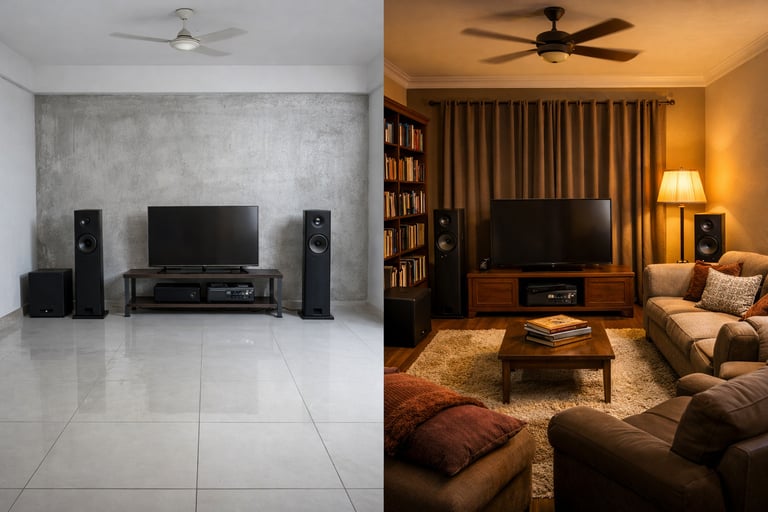
Most Indian homes feature a specific set of materials that are great for durability but terrible for sound. The result is a chaotic acoustic environment:
Hard Marble or Tile Floors: These reflect high-frequency sound aggressively, making audio feel "harsh" or "tinny."
Bare Concrete Walls: With minimal absorption, sound bounces indefinitely, creating a muddled mess.
Rectangular Layouts: The worst shape for "standing waves," where bass becomes boomy and overwhelming.
Ceiling Fans & Low Ceilings: Fans scatter sound unpredictably, while low ceilings disrupt the soundstage.
The Reality: A ₹5,000 speaker in a room with a rug and curtains will genuinely outperform a ₹50,000 speaker in a bare, tiled room.
The Sales Pitch vs. The Truth
Why don't brands tell you this? Because they want you to buy a new speaker, not a new rug.
Retailers use acoustically treated demo rooms with padded walls and carpets. You aren't hearing the speaker's true performance; you’re hearing its "best-case scenario." When you bring that same speaker home to your bare walls, the magic disappears.
The Solution: Technology That Adapts
Short of redesigning your home, the answer lies in Room Calibration. This is the core of our approach at Swarix.
Our systems use AI to map your space—detecting surface reflectivity and room dimensions. Instead of a flat preset, the audio is tuned in real-time to compensate for your room’s flaws. Combined with wooden enclosures that dampen resonance (unlike cheap plastic), the sound is optimized for where you actually live.
Try This Experiment
Before spending more on hardware, try this:
Play a song you know well on your current speakers.
Place a thick rug on the floor and pull heavy curtains over windows.
Play the song again.
The difference you hear is your room finally letting your speakers do their job. When you're ready to upgrade, choose a system that understands your space—don't just throw more watts at a bad room.


Innovate
Connect
info@swarix.com
© 2025. All rights reserved.