

Dolby Atmos on Soundbars: Feature or Just a Sticker?
Is Dolby Atmos on soundbars actually real or just marketing? Learn how it works, what you really get, and whether it’s worth it before buying.
My post content


Dolby Atmos: Is Your Soundbar Delivering The Real Experience?
Understanding the difference between "Supported" audio and "Physical" height—and how to get the experience you actually paid for.
You see the logo everywhere. It’s on the box, the shiny retail sticker, and the digital display of your new soundbar: DOLBY ATMOS. It’s the gold standard of modern cinema audio, promising a "bubble" of sound that wraps around and above you.
However, there is often a gap between format support and hardware capability. While many soundbars can decode a Dolby Atmos signal, the way they deliver that sound to your ears varies wildly. To get the true Atmos experience, physics must be on your side.
The Challenge of the "Z-Axis"
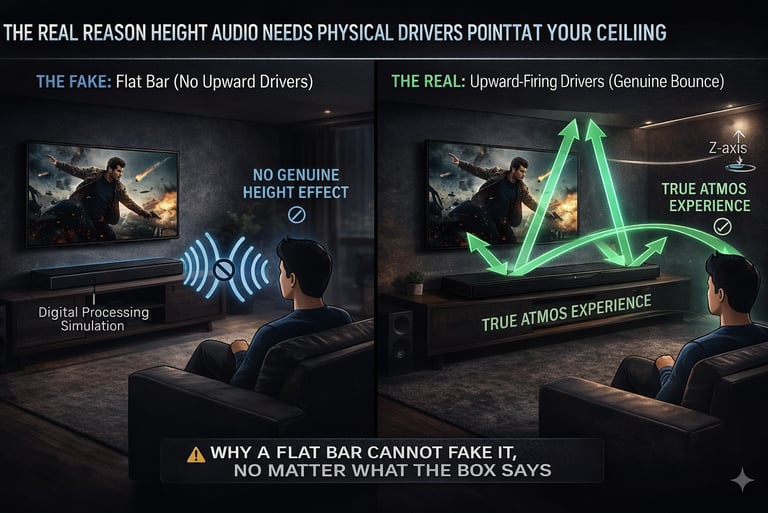
Traditional surround sound lives on a flat plane—front, back, left, and right. Dolby Atmos introduced the Z-axis (Height). Think of a rainstorm in a movie: in a perfect setup, that sound should physically originate from above your head.
For a soundbar sitting flat on a TV unit, creating height is a massive engineering challenge. There are two primary ways manufacturers handle this:
1. The Virtual Approach (Digital Processing)
Many entry-to-mid-range soundbars use Virtual Atmos. They don't have speakers aimed at the ceiling; instead, they use complex algorithms (DSP) to trick your brain into perceiving height.
The Reality: While impressive for its size, this is a digital simulation. It expands the soundstage, but it often lacks the "overhead" precision people expect from the Atmos name.
2. The Physical Approach (Upward-Firing Drivers)
Higher-end systems use physical drivers angled toward the ceiling to bounce sound down to the listener. This uses actual physics to create a height channel.
The Catch: This depends entirely on your room. If you have high ceilings, fans, or sound-absorbing materials, that "bounce" gets lost before it reaches your ears.
Why the "Sticker" Isn't Always the Story
When you see "Dolby Atmos Supported," it means the device understands the data. But a sticker cannot override the layout of your living room or the limitations of a flat speaker.
The most important thing to remember is that Atmos is an environment, not just a file format. To truly feel that helicopter flying overhead, you need a system that doesn't just "support" the badge, but has the physical hardware—and the room calibration—to make the physics work in your favor.
Why Your Room Matters More Than the Codec
Here's the deeper truth that the entire conversation about Atmos tends to skip over: even if your soundbar has proper upward-firing drivers, the quality of height audio you hear depends almost entirely on your room's acoustic properties.
A low, rough ceiling absorbs the reflected sound before it reaches you. A high ceiling delays it so long the timing feels wrong. A ceiling fan interrupts the path entirely. Furniture, curtains, and wall material all change how sound behaves.
This is why a soundbar that dynamically analyzes your room and adjusts its output accordingly can often deliver a more convincing spatial experience than a premium Atmos bar in the wrong room. The room isn't a passive container for sound — it's an active participant in the audio experience.
What Honest Height Audio Actually Sounds Like
When height audio works correctly, you stop noticing it. Rain doesn't just come from the sides — it comes from everywhere, including above you. A bird call in a forest scene rises and passes overhead. Dialogue stays anchored at the screen while ambient sounds wrap around you from all directions.
That sensation is available. But it requires either the right hardware in the right room — or a system intelligent enough to compensate for the room you actually have.
The Swarix Approach
At Swarix, we don't print codec logos as a substitute for acoustic honesty. Our systems combine hardware-level room scanning technology with AI-based sound optimization that maps your actual room — its size, shape, ceiling height, and surface materials — before tuning the output accordingly.
This means whether you're in a compact Mumbai flat with a 9-foot ceiling and a fan, or a spacious living room in Bangalore with 12-foot ceilings and floor-to-ceiling curtains, the sound you hear is tuned to your space — not to an anechoic test chamber in a lab.
We also use wood enclosures instead of plastic, which provides natural acoustic damping and reduces unwanted resonance — a detail that shapes every frequency you hear, not just the ones the marketing team chose to highlight.
The Bottom Line
Dolby Atmos is a real and impressive audio format. But a label is not a driver. A codec is not a speaker. And a spec sheet is not a room.
Before you pay a premium for Atmos support, ask one simple question: does this soundbar have physical upward-firing drivers, and has it been tested in a room that resembles mine?
If the answer is no to either, you're paying for a sticker. You deserve more than that.


Innovate
Connect
info@swarix.com
© 2025. All rights reserved.